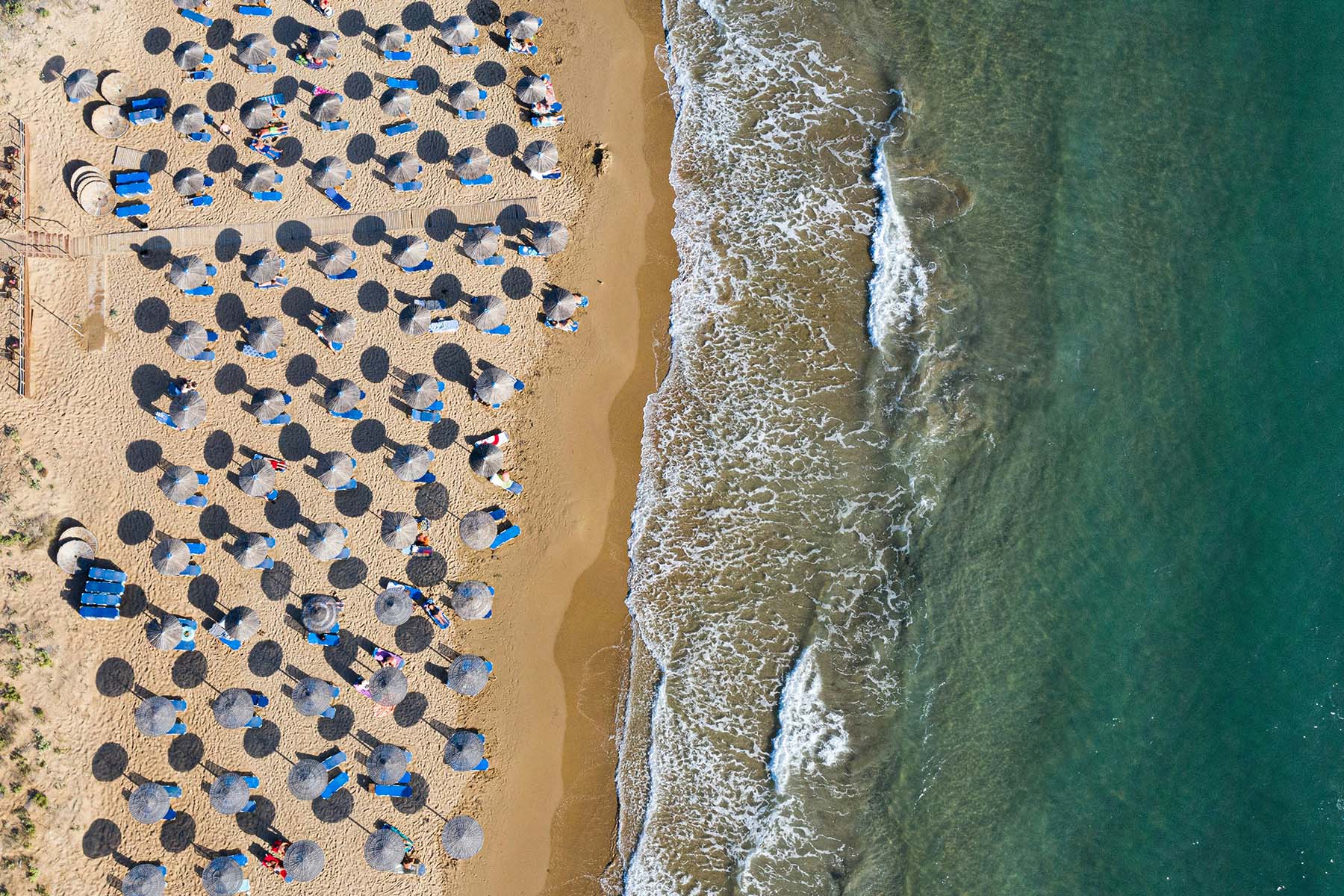
On a still November morning, the south-west of Corfu feels like a different island: empty dunes, still water and egrets lifting off the shallows. Korission Lagoon, which locals also call Lake Korission, is Corfu’s largest lagoon, and it is at its best when the summer crowds have gone. Here is what to see, when to go and how to get there, so you can add it to a week on the island.
What Is Korission Lagoon?
Korission is the largest lake on Corfu, with about 427 hectares of brackish water sitting just behind the sea. It formed when sand dunes cut the basin off from the open water, and today an artificial channel links it back to the sea. In summer the shallow water heats up and becomes saltier than the sea itself.
The lagoon sits inside a Natura 2000 area of about 2,300 hectares (site GR2230002), designated a Special Area of Conservation in 2011, and it is also a protected bird area and part of BirdLife’s “Lagoons of Kerkyra island” Important Bird Area. The state protected-areas unit for Kalamas, Acheron and Corfu manages the site, and conservation groups including WWF Greece, the Hellenic Ornithological Society and the local association Friends of Corfu have pushed for its protection.
Walking the Dunes and the Juniper Forest at Korission Lagoon
A Korission Lagoon hike is really a walk along the narrow strip of sand between the lake and the sea, which is up to about 200 metres wide. Official site descriptions call the stretch between Garziki point and the start of Agios Georgios beach “almost unaltered”, one of the few natural ecosystems left on Corfu.
The “Cedar” Forest on the Sand
The trees that locals call kedros, or cedar, are actually Phoenicean juniper. The stands on the southern sandy shore are considered the last remnants of such a forest on Corfu, and juniper growing on sandy beaches like this is very rare in Greece.
Dunes up to 15 Metres High
South of the channel, older dunes rise to around 15 metres; to the north, a lower, younger barrier has dunes of only a couple of metres. They shelter rare plants too: Korission is the only place in Greece where the dune plant Crucianella maritima has been reported. Stay on existing paths, never drive onto the sand or the dunes, and leave the juniper and dune plants alone.
Birds at Lake Korission Through the Seasons
Lake Korission birds are the main draw outside summer. The lagoon is an important passage and wintering site for waterbirds, and more than 120 species have been recorded around it. In winter, counts have found between 100 and 300 great egrets, along with cormorants in their hundreds, grey herons, teal, curlews and kingfishers.
And the Korission Lagoon flamingos? Greater flamingos often turn up from autumn into winter, but sightings depend on conditions and aren’t guaranteed. Spring and autumn migration bring the most variety, while black-winged stilts and Kentish plovers are a spring and summer sight.
Bring binoculars, come early in the morning or in the late afternoon when the light is soft, and keep your distance from resting flocks.
Why Visit Korission Lagoon Outside Summer
From late autumn the wintering birds are back and the dunes are empty. Summer is a different place: the heat is intense, the lagoon grows very salty, and on high fire-risk days the authorities can close the dune forest to people and vehicles. In summer, check fire-risk closures before you go. If you are exploring the quiet far south as well, our guide to the Arkoudilas and Kanouli beaches continues the route.
The Channel, the Fishermen and Gardiki Castle
Near the channel, a small wooden bridge leads into the juniper forest. Fishermen still work the lagoon here, and you may see their flat-bottomed boats, called koritos, pulled up by the small fishing station.
Gardiki Castle
Just north of the lagoon, on a low hill below Agios Mattheos, stand the walls of Gardiki Castle. According to the Ministry of Culture, it is one of three surviving Byzantine castles in Corfu’s countryside, alongside Kassiopi and its sister fortress, Angelokastro. It was probably built in the early 13th century under the Despotate of Epirus, with octagonal walls and eight two-storey towers, and its site was likely chosen to protect the spring and the neighbouring lagoon. It was abandoned in 1386, when the Venetians took Corfu.
Getting to Korission Lagoon
The lagoon is about 30 km from Corfu Town, roughly 45 minutes by car, and about an hour and a half from Roda. The nearest village is Linia, and the last stretch is on unpaved tracks, so a car is easiest. An automatic car is fine for most visitors, or choose a small 4×4 for the unpaved tracks; either way, stay on the tracks and never drive on the dunes. If you would rather not drive, book a private transfer, and see our guide to getting around Corfu for every option.
The long beaches on the sea side of the dunes are covered in our guide to Issos and Halikounas, and there is more to explore further up the south-west coast.
Korission Lagoon FAQ
Can you see flamingos at Korission Lagoon?
Often, from autumn into winter, but sightings depend on conditions and are never guaranteed.
Is Lake Korission the same as Korission Lagoon?
Yes, it is the same place. Lake Korission is the local name, but it is a lagoon linked to the sea by a channel.
How far is Korission Lagoon from Corfu Town?
About 30 km, roughly 45 minutes by car.
Is Korission Lagoon worth visiting in winter?
Yes. Winter brings egrets, herons and cormorants, empty dunes and quiet walks through the juniper forest.
Explore the South-West with Corfu Compass NSK
Whether you want a rental car for the south-west coast or a private driver, we can help. Contact Corfu Compass NSK to plan your Korission Lagoon day.