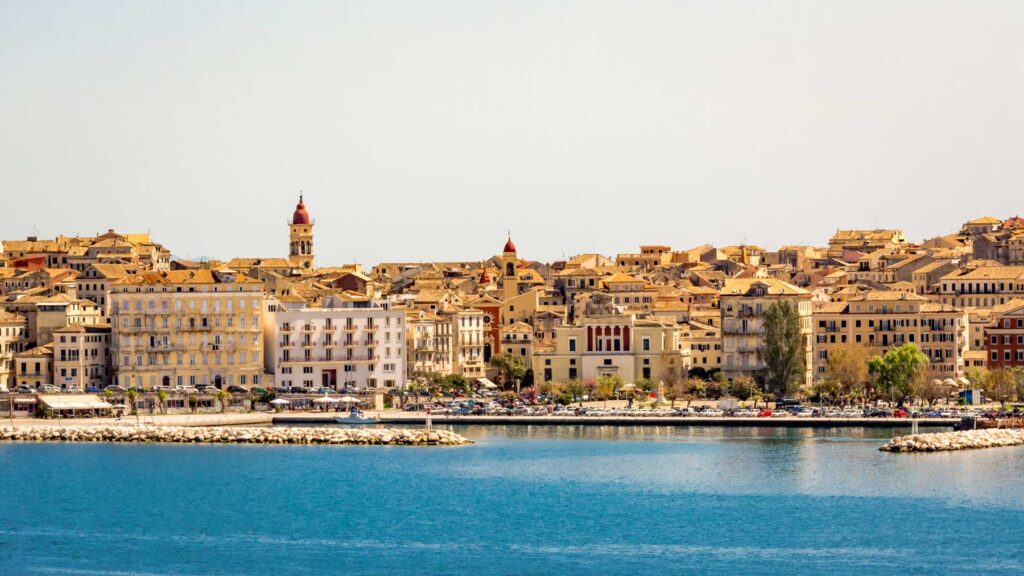
Saint Spyridon Church in Corfu is the spiritual heart of the island and one of the first places Corfiots will send you in the Old Town. Its tall bell tower with the red dome rises above the roofs and is the easiest landmark in town to navigate by. Inside, in a silver casket, rest the relics of Saint Spyridon, the patron saint who gives his name to half the men on the island. This guide covers the church’s history, what to look for inside, and how to visit respectfully.
Visiting Saint Spyridon Church: Key Information
- Where: Agiou Spyridonos Street, in the lanes of the Old Town just behind the Liston.
- Entry: free. Donations and candles are welcome.
- Opening hours: usually open daily from early morning until the evening. Hours can change on feast days and during services.
- Dress code: shoulders and knees covered. Carry a light scarf in summer.
- Photography: restricted inside. Look for signs or ask before you take a picture, and never photograph people praying.
- Time needed: 15–30 minutes, longer if there is a queue to the relics.
The church publishes no official schedule. Last checked 30 Oct 2026. If you have a fixed plan, check locally on the day.
Who Was Saint Spyridon?
Spyridon was a 4th-century bishop of Trimythous in Cyprus, remembered as a shepherd who became a bishop and as a miracle-worker. After his death his relics were taken to Constantinople. When the city fell to the Ottomans in 1453, they were smuggled out. In the second half of the 15th century they reached Corfu, brought by a priest, Georgios Kalochairetis. Sources give different dates for the arrival, so treat any single year you read with caution. The relics passed through a local family as part of a dowry before they found their permanent home in this church.
The History of Saint Spyridon Church Corfu
The present church was built in the late 16th century, around 1589–1590. It replaced an earlier church that stood outside the walls and was demolished when the Venetians strengthened the town’s defences. It is a single-nave basilica, simple on the outside and rich within. The bell tower was added in 1620. It is modelled on Venetian campaniles and is often described as the tallest in the Ionian Islands.
For Corfiots, the saint is far more than a historical figure. Corfu is one of the few parts of Greece never to fall under Ottoman rule, and local tradition credits Saint Spyridon with saving the island during the great siege of 1716. He is also credited with protecting it from famine and plague. The four yearly processions of his relics through the town remember these events. The August 11 procession marks the lifting of the 1716 siege.
What to See Inside
The relics and the silver casket
To the right of the iconostasis is a small chapel holding the saint’s relics in an ornate silver casket. Visitors queue quietly to pay their respects, and you will often see locals stop for a moment on their way to work. If you join the line, follow what others do and move along when it is your turn.
The marble iconostasis
The screen separating the sanctuary from the nave is made of white marble, carved and set with icons. It is one of the details people walk past too quickly, so take a minute with it.
The painted ceiling
Look up. The ceiling is divided into gilded panels showing scenes from the life of the saint. The original paintings, by the Ionian artist Panagiotis Doxaras in the 18th century, were damaged and later replaced with copies, so what you see today is a faithful reproduction of his scheme.
The silver lamps
Dozens of silver lamps hang from the ceiling. Many are gifts of thanks from individuals, families and even states. The best known is the large lamp given by the Venetian Senate after the siege of 1716.
Details above the door
Above the entrance, look for the coat of arms of the Russian imperial family, a reminder of the strong ties between Corfu’s Orthodox church and Russia in the 18th and 19th centuries.
How to Visit Respectfully
- Keep your voice low. This is a working church, not just a monument.
- During a service, stay at the back and do not walk in front of the congregation.
- Do not touch icons unless you are joining in worship.
- Candles are sold at the entrance. Light one if you wish, and leave a small donation.
- Visit early in the morning or late in the day for the calmest atmosphere. Around midday the church can fill with groups.
Combine It with a Walk Through the Old Town
Saint Spyridon is a few minutes’ walk from most of the Old Town’s other sights. From the church, continue to the Liston and the Spianada, cross to the Old Fortress, or head up into Campiello. Our guide to Venetian architecture in Corfu Old Town suggests a route, and the Jewish Quarter guide covers another side of the town’s history. For the rest of the island’s highlights, see our top places to visit in Corfu.
Getting There
The Old Town is largely pedestrian, and parking nearby is difficult in summer. If you are staying in the north or the resorts, let us take care of the transport:
- The Venetian Corfu heritage tour (about 5–7 hours) includes Kanoni, the Old Fortress and a walk through the Old Town past Saint Spyridon, the Palace of Saint Michael and Saint George and the Town Hall, with free time.
- The Corfu Town day or night trip gives you transport into town with free time to explore at your own pace. Saint Spyridon is on the route. Note that entrance fees for other sites are not included.
Saint Spyridon Church FAQ
Is there an entrance fee?
No. Entry is free.
Can I see the saint’s relics?
The casket is in the side chapel to the right of the iconostasis. On certain days it is opened for veneration. Ask the staff if you would like to know more.
When are the processions?
There are four each year. Read about the summer one in our guide to the August 11 Saint Spyridon procession.
See all our Corfu coach trips and visit Saint Spyridon with a local guide.