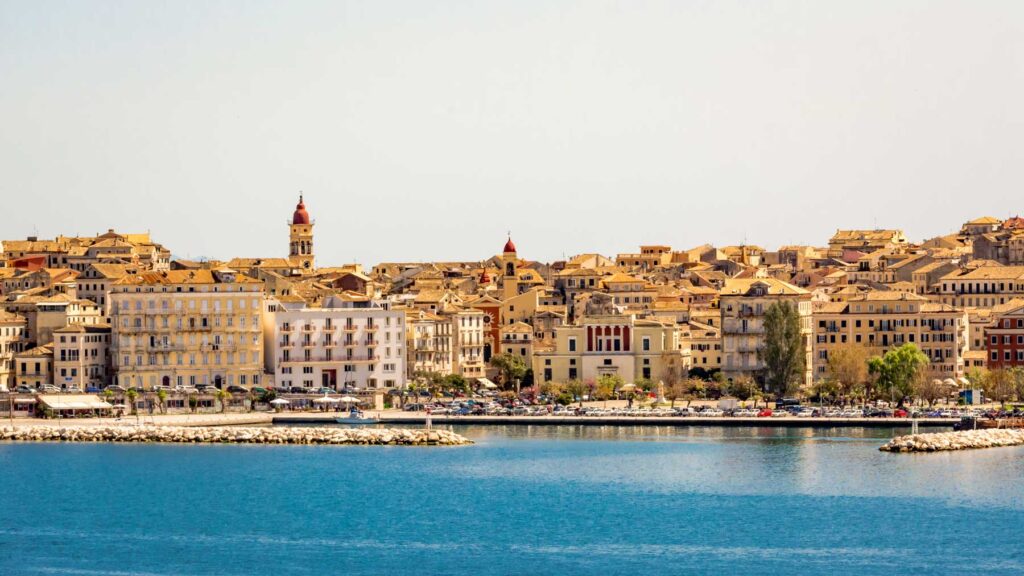
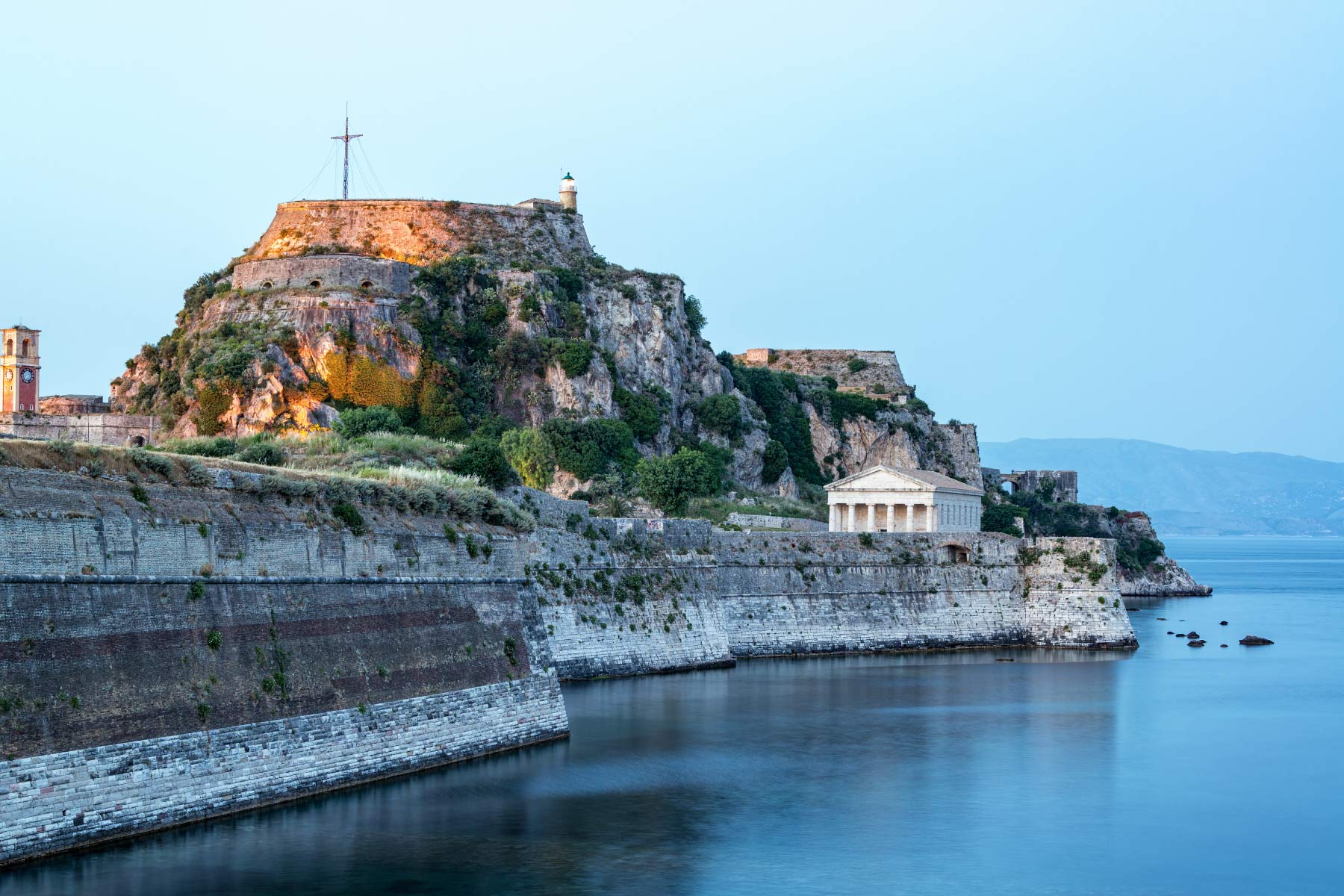
At the eastern end of Corfu Town, a rocky promontory with two peaks juts into the sea. Everything about the town in front of it exists because of what was built there. The Old Fortress is the reason Corfu was never taken, and the reason the Venetian Republic held the entrance to the Adriatic for four centuries.
Two Peaks and a Name
The promontory’s twin summits gave the town its Greek name. Korypho, meaning peak, became Corfu in Western usage — the island is called Kerkyra in Greek, but the international name comes straight from these two hills.
Fortification here began long before Venice arrived. The Byzantines built on the site after the old classical city further south was abandoned, and for a period the entire population of the town lived inside the walls.
The Canal That Made It an Island
The single most striking piece of engineering is the contrafossa — the sea-water moat the Venetians cut across the neck of the promontory, separating the fortress from the town entirely. It is a proper canal, not a ditch, and it is still there, crossed by a bridge that remains the only way in.
The logic was simple. An attacker who took the town still had to cross open water under fire to reach the citadel. Corfu Town could fall; the fortress would not.
The Sieges
Corfu sat directly on the fault line between Venice and the Ottoman Empire, and it was attacked repeatedly. The great sieges of the sixteenth and eighteenth centuries were among the largest military operations in the region, and the island held on each occasion.
The consequence reaches well beyond Corfu. Because the Ottomans never took the island, Corfu is the part of Greece that was never under Ottoman rule — which is why its architecture, its churches, its music and even its food look and sound more Italian than anywhere else in the country. The fortress is the direct cause of that difference.
What the British Added
After the Venetians came the French, and after the French the British, who held Corfu from 1815 to 1864. The British were responsible for much of what a visitor sees inside the walls today, including the barracks buildings and the church of St George at the base of the fortress — a Doric temple in appearance, built as a garrison chapel, which sits oddly and rather magnificently among the Venetian stonework.
The lighthouse on the higher peak also dates from the British period.
What to See Today
- The bridge and the contrafossa. Worth pausing on before you go in.
- St George’s church, immediately inside the gate.
- The climb to the lighthouse. Steep, uneven in places, and the best view in Corfu Town — the rooftops, the Spianada, the mountains behind and the sea on three sides.
- The Venetian well and the old barracks scattered across the site.
- The vaulted galleries and gun positions cut into the rock.
Allow an hour and a half at minimum. Wear something with grip; the stone is polished smooth in places.
Practical Notes
The fortress is open to visitors with an admission charge, and it is entirely exposed — there is almost no shade on the upper levels. Late afternoon in September is close to ideal: the heat has come off, the light is low across the town, and the walk up is comfortable.
Do not confuse it with the New Fortress on the other side of the town, which is a separate Venetian complex from a later period and worth its own visit.
See Corfu Town with Corfu Compass NSK
The Old Fortress is one stop in a town dense with layers — Venetian, French, British and Greek in the space of a few streets. Corfu Compass NSK runs guided tours of Corfu Town and transfers in from anywhere on the island, so you can spend the day walking rather than looking for parking.
Contact Corfu Compass NSK to book your Corfu Town tour or transfer.