Corfu Venetian architecture is the reason the historic centre of Kerkyra is on UNESCO’s World Heritage List. Venice ruled Corfu for roughly four centuries, from the late 14th century to 1797, and never stopped building: fortresses to hold the sea lanes, tall houses packed inside the walls, churches, wells and loggias. The French and British added their own layers later, but the bones of the town are Venetian. This guide walks you through what to look for, in an order that works on foot, with practical tips from those of us who come into town every week.
Corfu Venetian Architecture: Why the Old Town Looks This Way
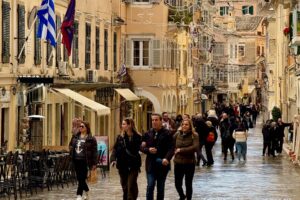
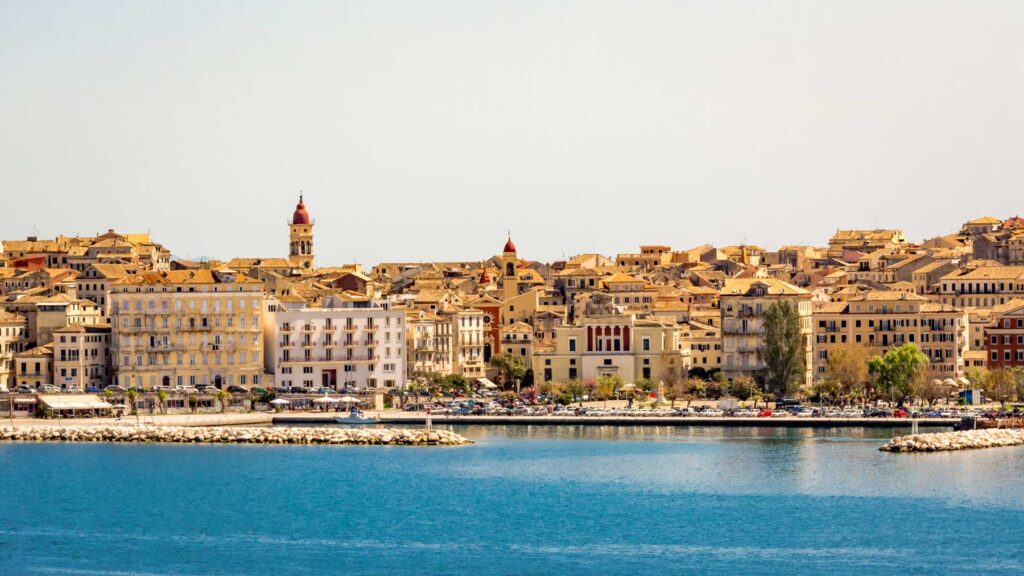
Corfu was the gateway to the Adriatic, and Venice treated it as a fortress first and a town second. Space inside the defences was limited, so houses grew upwards, often four or five storeys high, with narrow lanes between them called kantounia. Ground floors held workshops and storerooms; families lived above. Walk slowly and look up. You will notice arched doorways, stone balconies, carved lintels and the faded ochre, pink and cream façades that give the town its colour.
The Old Fortress
East of the town, across its moat, the Old Fortress is where Venetian military building on Corfu began, raised on the remains of an earlier Byzantine castle. It deserves a visit of its own, and our history of the Old Fortress covers the walls, the views and how to visit. On this walk, treat it as the starting point and the backdrop to the Spianada.
The New Fortress
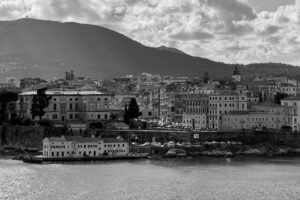
On the other side of the Old Town, above the old port, rises the New Fortress. The Venetians began building it in the late 16th century to protect the landward side of the town. Its massive walls are best seen from the streets below, near the market and the old port.
Spianada and the Liston
Between the Old Fortress and the town lies the Spianada, the great open square that the Venetians kept clear of buildings so their cannon had a free field of fire. It is often described as one of the largest squares in Greece and is now a park, with the cricket pitch a reminder of the British years. Along its western edge runs the Liston, the arcaded terrace built under the French in the early 19th century and modelled on Parisian arcades. Today it is lined with cafés. For the British side of the story, read our piece on British Corfu, cricket and ginger beer.
Campiello and Kremasti Square
Campiello, the oldest quarter of Corfu Town, is where the Venetian street plan survives best. It is a maze of stepped lanes, small squares and tall houses with laundry strung between balconies. Deep inside is Kremasti Square, a quiet corner with a carved Venetian stone well at its centre and the church of the Virgin Kremasti beside it. Do not worry about getting lost. Every downhill lane leads back to the sea.
Town Hall Square
A short walk uphill from the Liston brings you to the town hall, a 17th-century building that began life as a Venetian loggia for the nobility and later became the town’s first theatre. It sits on a sloping square with the Catholic Cathedral of Saint James and Saint Christopher. Together they form one of the most complete Venetian set-pieces in town.
Churches and the Bell Towers
Venetian Corfu was Orthodox in faith but Italian in style, and the churches show it. The tall red-domed bell tower of Saint Spyridon is the landmark you will navigate by. Inside, a silver lamp donated by the Venetian Senate hangs before the saint’s relics. Our guide to Saint Spyridon Church in Corfu has the visiting details.
Small Stops Worth Making
- Patounis soap workshop: a family business that has made olive-oil soap in town since the 19th century, still using traditional methods. Opening hours vary, so check before you go.
- The Cavalieri rooftop: the Cavalieri Hotel occupies an old mansion beside the Spianada. Its rooftop bar looks over the Old Fortress and the sea and is a good place to end the day.
- Food: for pastitsada, sofrito and where to eat them, see our culinary guide to Corfu Old Town.
A Simple Walking Route
- Start at the Old Fortress in the morning, before the heat, or simply admire it from the Spianada.
- Cross to the Spianada and take a coffee on the Liston.
- Walk into the lanes to Saint Spyridon Church.
- Continue up to Town Hall Square.
- Lose yourself in Campiello and find Kremasti Square.
- Finish at the old port, with the New Fortress above you. The old Jewish quarter, the Evraiki, is just inland from here: see our guide to the Evraiki and its surviving synagogue.
Allow at least half a day, with stops. The lanes are paved with smooth stone that gets slippery, so wear shoes with grip. Visiting from a cruise ship? Our one-day Corfu cruise ship guide fits this walk into a port day.
Practical Tips
- Parking: parking near the Old Town is hard in summer, and the centre is largely pedestrian. Arriving by coach or transfer is much easier.
- Churches: cover shoulders and knees, and keep your voice down when services are on.
- Heat: in July and August, plan your walking for the morning and early evening.
- Look up: many of the best Venetian details, such as carved lintels, coats of arms and stone balconies, are above eye level, so slow down in the narrow lanes.
- Shops: many smaller shops close for a few hours in the afternoon outside high season.
See Venetian Corfu with a Guide
The Venetian Corfu heritage tour (about 5–7 hours) combines Kanoni and Mouse Island, the Old Fortress and a walk through the Old Town, past the Palace of Saint Michael and Saint George, the Town Hall and Saint Spyridon, with free time to explore. If you would rather explore on your own, our Corfu Town day or night trip takes care of the transport from your hotel. For other ideas around the island, see our top places to visit in Corfu.
See all our Corfu coach trips, including the Venetian Corfu heritage tour of the Old Town.